How to get your driveway ready before the first snow
A Bucks County crew's checklist for getting your driveway, walkways and yard ready before the first snow in Newtown, Yardley, Langhorne and nearby towns.
In Lower Bucks County, the first plowable snow usually arrives after the leaves are down and before most people have thought about it. From Newtown and Yardley to Langhorne, Holland and Morrisville, the homes that get through winter easiest are the ones that spent an hour getting ready in early December.
Our winters are rarely about one giant storm. They are about a run of small and mid-size snows, wet slush, and nights that drop below freezing after days that melt. That freeze-thaw cycle is what turns a cleared driveway into a sheet of ice, cracks concrete and heaves pavers. A little preparation now takes most of the sting out of it.
This is the checklist our crews use on our own snow routes, in the order that matters.
1. Finish the last leaf cleanup before the ground freezes
Wet leaves left on a lawn under snow mat down and smother the grass, and you'll see the dead patches in April. Leaves left in beds and along the driveway also hide edges and turn to slick mush under a plow. If you still have a final cleanup to do, it's worth doing before mid-December. Book a leaf cleanup while crews still have room.
2. Clean the gutters one last time
Gutters packed with late leaves overflow when snow melts during the day, and the water refreezes on your walkway and steps overnight. That's where most winter slips happen. On the heavy clay soils common across Bucks County, overflow that lands next to the foundation also has nowhere to drain, which is how a lot of basements start to seep in January. A final gutter cleaning after the last leaves fall stops it at the source.
3. Mark your driveway and walkway edges
Once snow covers the ground, the edge of a driveway disappears, and blades catch the lawn, the mulch beds and the curb. Reflective stakes on both sides of the driveway, and at every corner and turn, show exactly where to stop. Put them in before the ground freezes, or they won't go in at all.
Mark anything else a blade could hit while you're at it: landscape lights, a low wall, the edge of a paver walk, sprinkler heads near the pavement, and the end of a curved apron where it meets the street.
4. Clear what the snow will hide
Walk the driveway and walkways and pick up hoses, decorations, loose stones and fallen branches. Pull planters back from the edges. Anything left out becomes something a plow hits or someone trips on.
Holiday decorations deserve a second look. Extension cords run across a walkway, or inflatables staked at the edge of the driveway, end up buried under the first pile of snow. Route cords along the house, not across the path.
5. Find the problem spots now
After the next rain, look for where water pools on the driveway and walkways. Those low spots are where meltwater refreezes into the slickest ice on the property, and they need ice melt first after every storm. Note cracks too: water gets in, freezes and widens them through the winter.
Also notice where the sun never reaches. A north-facing walk or a stretch of driveway shaded by evergreens can hold ice for days after the rest of the property is dry. Those are the spots to watch on cold mornings after a thaw.
6. Plan where the snow goes
Every storm needs a place to pile snow. The right spot doesn't block your view backing out, doesn't melt back across the driveway, and doesn't bury shrubs that can snap under the weight. Tell your snow crew where you want it before the first storm, not during it.
Keep piles off the low side of the driveway if you can. Snow stacked uphill melts downhill every sunny afternoon, and that water freezes across the pavement overnight.
7. Use the right ice melt, the right way
Rock salt is cheap, but it's hard on concrete less than a year old, on lawns and beds along the edges, and on pets' paws. Use a product made for your surface, spread a thin, even layer, and put it down early in a storm rather than after the ice has formed. More is not better: piles just wash into the lawn.
Keep a bag by the door you use most, with a scoop, so treating the steps takes thirty seconds instead of a trip to the garage in the dark.
8. Know what your township expects
Many Bucks County townships and boroughs require homeowners to clear public sidewalks within a set time after a storm ends. The rules differ from Newtown to Morrisville to Levittown, so check your municipality's website once, before the season starts, and plan around it.
9. Get on a snow route before the first storm
Snow crews fill their routes in November and December. Once a route is full, it's full, because every extra stop slows down everyone already on it. Waiting until the forecast shows a storm usually means waiting too long.
How Galaxy handles snow
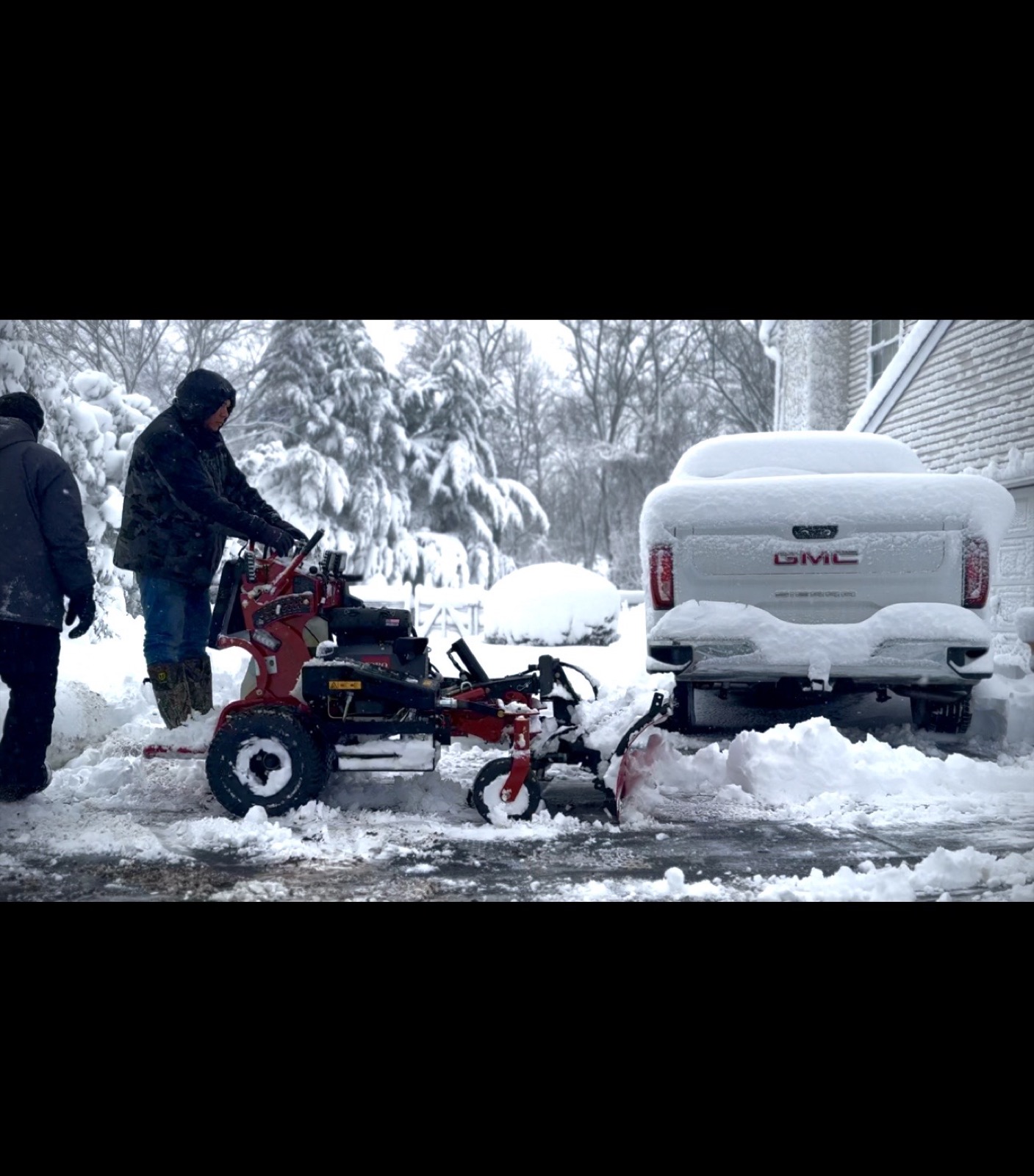
Galaxy runs one snow service for every home on our routes, all winter long, split into 4 payments. We aim to reach every home within 24 hours after the snow stops, and we come back at no extra charge in storms of 8 inches or more. Ice melt application is available too. Our routes cover Newtown, Yardley, Langhorne, Holland, Richboro, Washington Crossing, Morrisville, Levittown, Fairless Hills and nearby towns, and spots are limited because each crew can only clear so many driveways after a storm.
If you'd rather spend snow mornings inside, check snow service for your address and see whether there's still room on the route near you.
Questions we hear
When should I get ready for snow in Bucks County?
Early December. The first plowable snow in Lower Bucks usually shows up after the leaves are down, and stakes, cleanups and gutter work all go faster before the ground freezes.
Do I really need driveway stakes?
Yes, especially if your driveway borders lawn or mulch beds. Once snow covers the edges, stakes are the only way an operator can see where pavement ends and your yard begins.
What is the best way to use ice melt?
Use a product made for your surface, spread a thin, even layer, and put it down early in a storm. Thick piles do not work better and wash into your lawn and beds.
How does Galaxy's snow service work?
It is one seasonal service for every home on our routes, split into 4 payments. We aim to reach every home within 24 hours after the snow stops, and in storms of 8 inches or more we come back at no extra charge.